Ontario Hearing Aid Funding: The Complete ADP Funding Guide (2026)
A quick guide on hearing aid funding in Ontario.
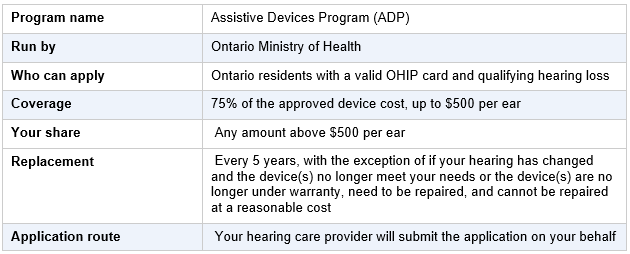
Ontario’s Assistive Devices Program (ADP) covers 75% of the approved cost of a hearing aid, up to a maximum of $500 per ear. Most Ontario residents with a confirmed permanent hearing loss qualify.
This guide explains exactly who qualifies, what is covered, how to apply, and how to stack ADP funding with private insurance to maximise your savings.
ADP at a Glance
Who Qualifies for Ontario ADP?
To receive ADP funding for a hearing aid, you must meet all of the following criteria:
Ontario Residency and OHIP Coverage
You must be an Ontario resident with a valid OHIP card. Temporary residents, visitors, and those without OHIP do not qualify.
Audiological Assessment
You must have a hearing test confirming a permanent hearing loss that meets ADP’s eligibility threshold.
Hearing Aid Recommendation
Your audiologist or registered hearing instrument specialist (HIS) must confirm that a hearing aid is the appropriate intervention and that you are unlikely to benefit substantially from other treatment alone.
ADP-Authorized Provider
Your hearing device must be prescribed and fitted by an ADP-authorized provider.
Who does NOT qualify:
Those whose hearing loss does not meet the minimum audiometric threshold as outlined by ADP
Residents without a valid OHIP card
Those who have already received ADP funding for the same device within the replacement window (with limited exceptions)
What Does ADP Cover?
Covered Devices
ADP covers conventional hearing aids across a range of styles: behind-the-ear (BTE), receiver-in-canal (RIC), in-the-ear (ITE), in-the-canal (ITC), and completely-in-canal (CIC) devices are all eligible.
Approved Device List
ADP maintains a list of approved hearing aid models. Not every device on the market is eligible. Your provider will know which models qualify and will provide you with recommendations based on your hearing assessment results and the ADP approved devices.
What ADP Does NOT Cover
Batteries and accessories
Extended warranties
Replacement devices due to misuse and/or neglect
Hearing aid(s) from non-ADP-authorized providers
Devices purchased prior to ADP authorization
How Much Will I Actually Pay?
ADP will cover 75% of the approved device cost, up to $500 per ear. This means that you would be responsible for any cost above the $500 per ear.
For example, if a cost of 1 hearing aid is $2,000, ADP will cover $500 of this cost. Your out-of-pocket cost would be the remaining $1,500.
If you are purchasing a pair of hearing aids and the cost of this pair is $4,000, ADP will cover $1,000 of this cost ($500 per ear). Your out-of-pocket cost would be the remaining $3,000.
Important: The $500 funding from ADP applies per device. For a pair (two hearing aids), ADP pays up to $1,000 total.
The $500 cap is relatively modest compared to the actual market price of most hearing aids ($1,000–$4,000 per device). ADP funding helps, but most Ontarians will still have a meaningful out-of-pocket cost unless they also have private insurance that includes hearing aid coverage.
How to Apply for ADP
The ADP application process is largely handled by your hearing care provider. Here’s what to expect:
Step 1: Book an Audiological Assessment
Visit an audiologist or registered hearing instrument specialist for a complete audiological assessment.
Step 2: Receive a Device Recommendation
If your hearing loss qualifies, your provider will recommend an appropriate device and confirm ADP eligibility.
Step 3: Provider Submits the Application
Your hearing care provider will help you complete and submit the ADP application.
Step 4: Approval and Funding
Once approval from ADP is received, you can purchase your hearing aids. You will be required to pay your out-of-pocket cost, and the government will pay their portion directly to the provider.
Important: Do not purchase the hearing aid before the ADP claim is approved — retroactive claims are generally not accepted.
Combining ADP with Private Insurance
If your employer benefit plan or private health insurance includes hearing aid coverage, you can “stack” ADP funding with this additional coverage.
It is always best to consult with your insurance provider to confirm coverage eligibility.
Veterans and WSIB
Veterans Affairs Canada (VAC): Veterans with service-related hearing loss may receive full coverage through VAC, separate from ADP.
WSIB: If your hearing loss resulted from workplace noise exposure, WSIB may cover the full cost, separate from ADP.
If you think you may be eligible for VAC or WSIB coverage, consult with a hearing care professional to learn more about the application process and coverage.
Frequently Asked Questions
Does Ontario ADP cover both hearing aids if I need two?
Yes. ADP covers eligible devices for both ears if both ears have qualifying hearing loss. The $500 maximum applies per device, which is up to $1,000 for a pair.
Can I choose any hearing aid with ADP?
You must choose from the ADP’s list of approved devices. Your hearing care provider will be able to make recommendations based on the results of your hearing test along with the ADP approved devices.
What if I want a hearing aid that costs more than what ADP approves?
You can pay the difference yourself. Your provider will apply the ADP subsidy to the approved amount, and you pay the remainder out of pocket. This is common, as many preferred models cost more than what ADP’s subsidy covers.
Is the ADP application means-tested?
No. ADP is not income-tested. If you meet the audiological criteria and are an Ontario resident with an OHIP card, you qualify regardless of your income level.
Sources
Ontario Ministry of Health — Assistive Devices Program (Hearing Devices): ontario.ca/page/hearing-devices
OHIP Card Eligibility — Government of Ontario: ontario.ca/page/apply-ohip-and-get-health-card
CASLPO (College of Audiologists and Speech-Language Pathologists of Ontario): caslpo.com
Written by
Alyssa Valentini
B.Sc., M.Cl.Sc., R.Aud